Overview
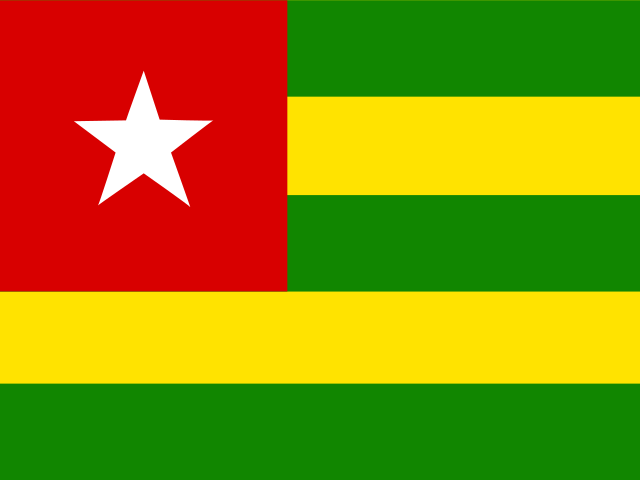
The Togo national football team, nicknamed Les Éperviers (The Sparrowhawks), represents Togo in international men's football. The Togolese Football Federation was established in the 1960s and the team has competed intermittently in continental competitions since the 1960s and in global qualifying since joining FIFA in 1964. Togo’s colors are typically yellow, green and red, reflecting the national flag.
History and development
- Early decades: Togo spent much of its early history building domestic structures and gaining experience in regional and African competition. The team’s appearances at major tournaments were occasional through the 1970s–1990s.
- Rise to prominence: The first decade of the 2000s saw the emergence of a generation of players who gave Togo consistent competitive teeth on the continent and made the national side more visible internationally.
- 2006 World Cup breakthrough: The high point in Togo’s history came in 2006, when the country qualified for the FIFA World Cup for the first time. That qualification markedly raised the profile of Togolese soccer worldwide.
- Tragedy and turmoil: In January 2010, while traveling to the Africa Cup of Nations in Angola, the Togo team bus was attacked in the Angolan exclave Cabinda. Several people were killed or injured and Togo withdrew from the tournament. The incident had a lasting impact on the team and federation.
- Recent years: Since 2010 the team has gone through cycles of rebuilding, with fluctuating results in Africa Cup of Nations qualifying and in World Cup qualification, relying on both home-based talent and Togolese professionals abroad.
Major successes and milestones
- 2006 FIFA World Cup qualification — Togo’s first and only appearance at the World Cup to date, marking the country’s single biggest international achievement.
- Multiple Africa Cup of Nations qualifications — Togo has qualified for AFCON on several occasions, giving the team competitive exposure against Africa’s stronger national sides.
- Raising the profile of Togolese football — the international careers of a few high-profile Togolese professionals helped put Togo on the global football map and inspired development at home.
Most notable players
- Emmanuel Adebayor — By far Togo’s best-known player in the modern era. Adebayor captained the national team and enjoyed a high-profile club career with teams including Arsenal, Manchester City and Real Madrid. He is the most prominent figure in Togolese football history and a key reason for the country’s higher international profile.
- Moustapha Salifou — A combative central midfielder who had spells in European leagues, most notably a period at Aston Villa in the English Premier League. He was a mainstay in midfield for Togo for many years.
- Thomas Dossevi — A long-serving winger/attacking player who spent most of his club career in France and contributed regularly to the national team during the 2000s.
- Domestic and diaspora contributors — Beyond those above, Togo’s squads have included a mix of domestic stalwarts and Togolese professionals based in France, Switzerland and other European leagues who have been important for qualification campaigns and leadership on the pitch.
Notable coaches
- Otto Pfister (Germany) — A veteran coach who played a key role in Togo’s most successful era, including the qualification for the 2006 World Cup. Pfister is widely credited with professionalizing preparations and tactics during that period.
- Hubert Velud (France) — Coach of the side around the time of the 2010 Africa Cup of Nations attack; his tenure is associated with that difficult chapter in the team’s history.
- Other foreign and domestic coaches — Over the years Togo has used a mix of experienced foreign coaches and local managers as the federation has sought the right balance to develop talent and deliver results.
Legacy and current status
Togo’s football legacy rests largely on the 2006 World Cup qualification and the international careers of players like Emmanuel Adebayor, who inspired a generation. The 2010 attack was a tragic setback with lasting consequences, but Togolese football continues to produce players who compete in Europe and Africa. The national team remains a competitive side in West Africa and periodically challenges for places at AFCON and in World Cup qualifying, while working to strengthen its domestic league and youth development pathways.
Summary
Togo is a national team with a modest but meaningful international footprint: a landmark World Cup appearance, several AFCON participations, a few high-profile export players, and a history marked by both sporting pride and adversity. The team remains an important part of Togolese national identity and continues efforts to build more consistent success on the continental and world stage.
| # | Name | Nat. | Position | Value |
|---|---|---|---|---|
| 1 |
 ASSOGBI ASSOGBI
|
 TOG
TOG
|
G | £130k |
| 2 |
APEDO
|
TOG
|
RB | £110k |
| 3 |
WAZO
|
TOG
|
LB | £110k |
| 4 |
ABALO
|
TOG
|
D | £160k |
| 5 |
HOUNKPATI
|
TOG
|
D | £100k |
| 6 |
AGUNYO
|
TOG
|
RW | £110k |
| 7 |
TEYBOU
|
TOG
|
LW | £110k |
| 8 |
ATAYI
|
TOG
|
M | £180k |
| 9 |
KASSIM
|
TOG
|
A | £130k |
| 10 |
YACOUBOU
|
TOG
|
M | £150k |
| 11 |
ABALO
|
TOG
|
A | £110k |
| 12 |
HAMZA
|
TOG
|
G | £65k |
| 13 |
FIAWOO
|
TOG
|
D | £85k |
| 14 |
AKPALO
|
TOG
|
M | £85k |
| 15 |
SALISSU
|
TOG
|
A | £85k |
| 16 |
ALONGU
|
TOG
|
A | £75k |
ABALO
HOUNKPATI
WAZO
ATAYI
YACOUBOU
TEYBOU
ABALO