Overview
The Sri Lanka national soccer team (nicknamed the “Lankan Lions” or “Golden Lions”) represents Sri Lanka in international football. The team is governed by the Football Federation of Sri Lanka (now Sri Lanka Football Association) and is a member of the Asian Football Confederation (AFC) and the South Asian Football Federation (SAFF). Sri Lanka’s football history is long but modest on the international stage, with its strongest regional presence within South Asia rather than on the larger Asian or global stage.
History
- Early years (pre-1948 and 1948–1960s): Football was introduced to Ceylon (as Sri Lanka was known until 1972) during the British colonial period. Local clubs and school competitions developed in the early 20th century. The national side played informal and regional matches before independence in 1948 and began participating in officially organized international competition in the mid‑20th century.
- Growth and regional competition (1960s–1990s): Sri Lanka took part intermittently in Asian competitions and regional tournaments. The team often competed in the South Asian Championship (the precursor to SAFF tournaments) and in qualifying rounds for the Asian Cup and FIFA World Cup, generally struggling against stronger Asian teams but remaining active at the South Asian level.
- Modern era (2000s–present): In the 21st century Sri Lanka has continued as a lower-ranked Asian nation, focusing on regional success in SAFF and development programs at youth and domestic levels. Political and administrative challenges, limited resources, and competition from cricket as the nation’s dominant sport have constrained rapid progress. Still, Sri Lanka has remained a persistent participant in qualifiers and regional tournaments and has pursued reforms to improve coaching, youth development and domestic leagues.
Major successes and notable results
- SAFF / South Asian competitions: Sri Lanka’s most meaningful achievements are at the South Asian level. The team has reached later stages of regional competitions at times and recorded notable wins against neighboring nations. While Sri Lanka has not won the SAFF Championship (India, Pakistan, Maldives and Nepal have historically been stronger), it has produced competitive performances and occasional upsets in the tournament and its predecessors.
- South Asian Games / other regional events: Sri Lanka has had modest placings and occasional medal-winning performances in multi-sport regional events such as the South Asian Games, particularly during periods when the team fielded experienced or well-prepared squads.
- Historic and memorable results: Over the decades Sri Lanka has recorded notable victories over regional rivals and achieved occasional surprise results in AFC qualification matches or friendly competitions. These wins are important locally and have helped spur interest in the sport.
- Club and domestic impact: Successes have often come indirectly via domestic clubs and youth programs that feed the national team; improvements in the domestic league and youth coaching are seen as the route to better international outcomes.
Most notable players
- Channa Ediri Bandanage — One of Sri Lanka’s most famous international players, a forward known for goal scoring and for playing many years both domestically and in regional leagues. He served as an important attacking figure and captain at times.
- Kasun Jayasuriya — A forward/striker who was a key figure in the Sri Lankan attack during his international career, earning recognition for goals and leadership.
- Clifford Miranda (influence context) — While better known as an Indian player/coach, Sri Lanka occasionally features players who have regional club experience and cross-border influence; Sri Lanka’s best talents often include players who have plied trade in India or other South Asian leagues.
- Other long-serving internationals — Over the years Sri Lanka has had a number of committed players who earned many caps and provided leadership: goalkeepers and central defenders who formed the backbone of several competitive Sri Lankan sides. Names include veteran goalkeepers and midfield anchors known domestically and regionally.
Most notable coaches
- Local coaches — Sri Lanka’s national team history has been shaped largely by local coaches who understand the domestic game and its constraints. These coaches emphasized organization, defensive structure and maximizing the available talent.
- Foreign coaches and technical directors — At various times Sri Lanka hired foreign coaches or technical advisers (from South Asia, Europe and East Asia) to improve tactics, conditioning and youth development. These appointments brought fresh methods and had varying degrees of short‑term impact.
- Prominent names: Specific widely recognized successful long‑term coaches for Sri Lanka have been fewer than in larger footballing countries; notable coaching figures are often those who achieved surprising regional results or helped implement structural changes in youth development and domestic coaching standards.
Challenges and prospects
- Cricket’s dominance in Sri Lanka limits resources and public attention available for football.
- Infrastructure, finance and governance issues have at times hampered consistent development.
- Recent efforts have focused on improving youth academies, coaching education, the domestic league structure and international exposure—areas seen as key to raising Sri Lanka’s competitive level in Asia.
Summary
Sri Lanka’s national team is a proud, long-standing member of Asian and South Asian football with its greatest competitiveness at the regional level. While it has not yet achieved major success on the larger Asian or world stage, the team’s history includes memorable regional performances, committed players who became domestic icons, and ongoing efforts to improve through better coaching and youth development. Continued investment in infrastructure and talent pathways is the main route to stronger future results.
| # | Name | Nat. | Position | Value |
|---|---|---|---|---|
| 1 |
 LOFITH WEERASINGHE LOFITH WEERASINGHE
|
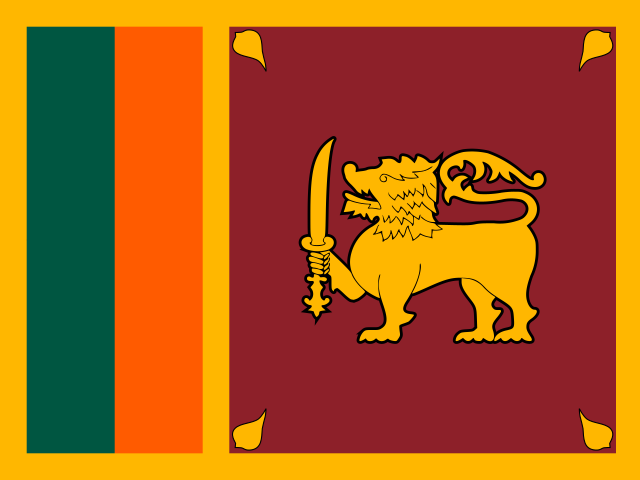 SRI
SRI
|
G | £40k |
| 2 |
SAMPATH PERERA
|
SRI
|
RB | £40k |
| 3 |
JUNAIDEEN HASSIMADEEN
|
SRI
|
LB | £50k |
| 4 |
ANANDA ANTHONYPILLAI
|
SRI
|
D | £40k |
| 5 |
PRABATH FERDINAND
|
SRI
|
D | £85k |
| 6 |
JOSEPH SHANTHAKUMAR
|
SRI
|
RW | £40k |
| 7 |
MAIDOO MOHAMED USMAN
|
SRI
|
LW | £65k |
| 8 |
DUDLEY STAINWALL
|
SRI
|
M | £75k |
| 9 |
K.M. KABEER
|
SRI
|
A | £65k |
| 10 |
B.R.A. PREENA
|
SRI
|
M | £50k |
| 11 |
ROSHAN PEREIRA
|
SRI
|
A | £85k |
| 12 |
SUJITH HEMANTHA
|
SRI
|
G | £<25k |
| 13 |
U.L. NIHAL
|
SRI
|
D | £30k |
| 14 |
WALDO FERNANDO
|
SRI
|
M | £30k |
| 15 |
A. DEVENDRA
|
SRI
|
A | £25k |
| 16 |
SUMITH PEREIRA
|
SRI
|
A | £30k |
ANTHONYPILLAI
FERDINAND
HASSIMADEEN
STAINWALL
PREENA
USMAN
PEREIRA